Sept. 4, 2026
By Alyce Brogan

This week’s announcement that Reach Volunteering is to close after more than 45 years really stopped me.
Reach isn't closing because its work is no longer needed. Quite the opposite. The organisation itself says the need for what it does has never been more urgent, but a changing funding landscape has made the model increasingly difficult to sustain.
And sadly, it's not an isolated story. Indeed, the latest Good Merger Index found 94 charity mergers involving 183 organisations between May 2024 and April 2025, a 49% increase on the previous period, with “mergers for survival” becoming an important theme.
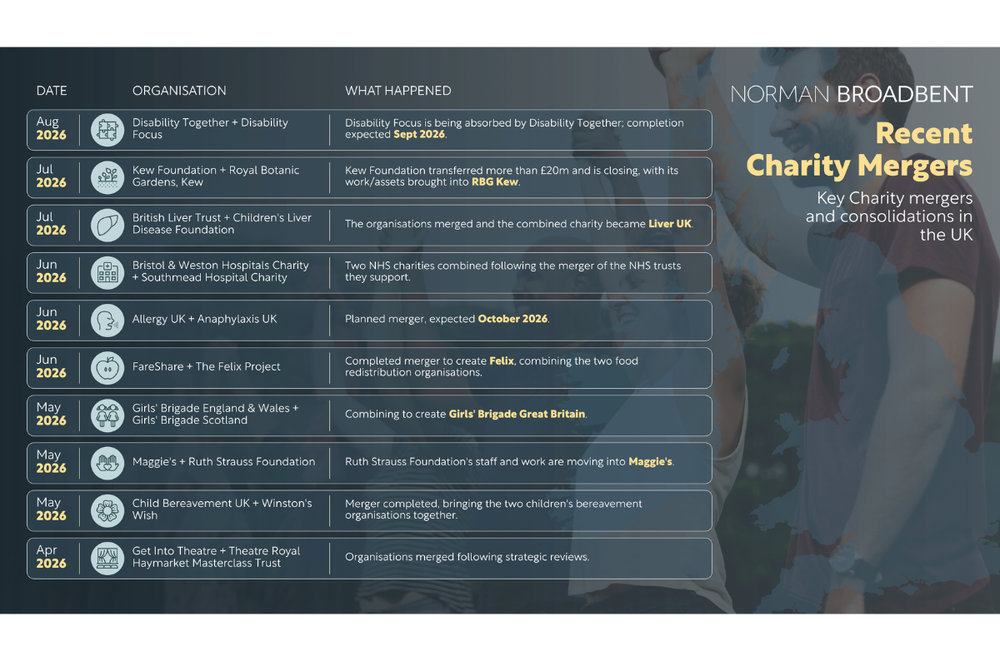
More recently, we've seen Disability Together and Disability Focus announce a merger to strengthen financial resilience, while the Samuel Lithgow Youth Centre has been dissolved and its assets transferred to Fitzrovia Youth in Action after financial difficulties threatened its future. The following graphic show examples of several other transactions which have all been announced within the last six months.
These aren't necessarily stories of organisations getting things wrong. They are fundamentally stories about scarcity and hard choices.
Across the charity sector, organisations are being asked to respond to rising demand while navigating higher costs, increasingly constrained funding, and changing expectations from funders and commissioners.
The important question in such circumstances is not just how an organisation can be preserved in its existing form, it’s what really needs to endure: the outcomes it creates, the services on which people depend, the expertise it has assembled, or the relationships and trust it has built. Sometimes the best way to protect those things will be to make difficult choices about what to stop, what to combine and, in some cases, whether another organisation is better placed to carry the work forward.
Perhaps the most important question is no longer how charities can continue doing everything with less, but how boards and leaders identify what matters most and act early enough to protect it. That requires honest prioritisation, a willingness to stop activities whose impact no longer justifies their cost, and openness to collaboration, merger or transfer where these offer a better way of sustaining the mission.
In a period of genuine scarcity, preserving every organisation in its current form may be impossible. Preserving the greatest possible value for beneficiaries must remain the goal. That may require some of the hardest decisions a charity leader or board will ever have to make. But in the current environment, recognising when an organisation needs to change, and acting early enough to protect what matters most, may itself be one of the most important acts of leadership.